O-Pee-Chee Hockey Cards: History and Value Guide
If you collect hockey cards long enough, you develop a soft spot for O-Pee-Chee: the rough cuts, the bilingual backs, the wax stains. The Canadian brand made hockey’s most important cards for three decades, including the most valuable hockey card ever sold. This guide covers the history that matters, which eras hold value, and how to price the OPC in your collection.
Key Takeaways
- O-Pee-Chee was hockey's flagship card maker from the late 1960s through the 1980s.
- OPC cards usually outvalue identical Topps versions: smaller print runs, tougher condition, Canadian cachet.
- The money lives in 1968-1987. OPC from 1988-1994 is junk wax like everything else.
- Rough factory cuts make high-grade vintage OPC genuinely scarce, so grades drive huge premiums.
Table of Contents
A Short History of O-Pee-Chee
O-Pee-Chee started as a candy company in London, Ontario in 1911, and like Topps in the US, cards began as something to move gum. From 1968 onward, OPC and Topps ran a long partnership: same designs, largely same photos, with OPC printing the Canadian version with bilingual English-French backs and bigger checklists that went deeper into NHL rosters.
That arrangement made OPC the true home of hockey cards. The NHL is a Canadian-hearted league, OPC sets covered more of it, and generations of Canadian kids (and later, collectors like me in Vancouver) grew up on OPC wax. The company stopped producing cards in the mid-90s, and today Upper Deck keeps the brand alive as its retro-styled affordable line.
O-Pee-Chee vs Topps
The single most useful thing to know: for the same card in the same year, the O-Pee-Chee version usually sells for more, and in high grades the gap gets dramatic.
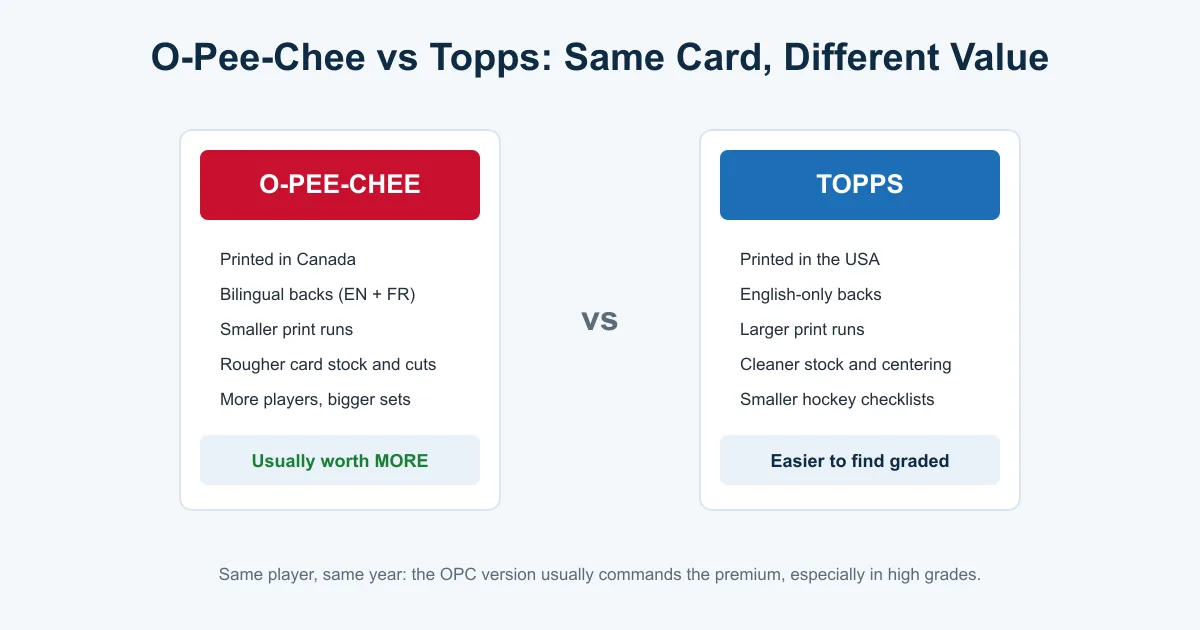
Three reasons drive the OPC premium:
- Smaller print runs. The Canadian market was smaller, so OPC printed less. Decades later, that’s raw scarcity.
- Condition scarcity. OPC’s card stock and famously rough factory cuts mean fewer high-grade survivors. A card that’s plentiful in PSA 8 can be nearly impossible in PSA 10, and the PSA population report proves it card by card.
- Hobby cachet. Hockey collectors simply want the Canadian version. Demand follows sentiment.
Practical takeaway: if you’re holding both versions of the same vintage card, the OPC is almost always the one to grade first, and the Topps is often the one to buy if you just want the card for your collection at a discount.
The OPC Eras That Matter
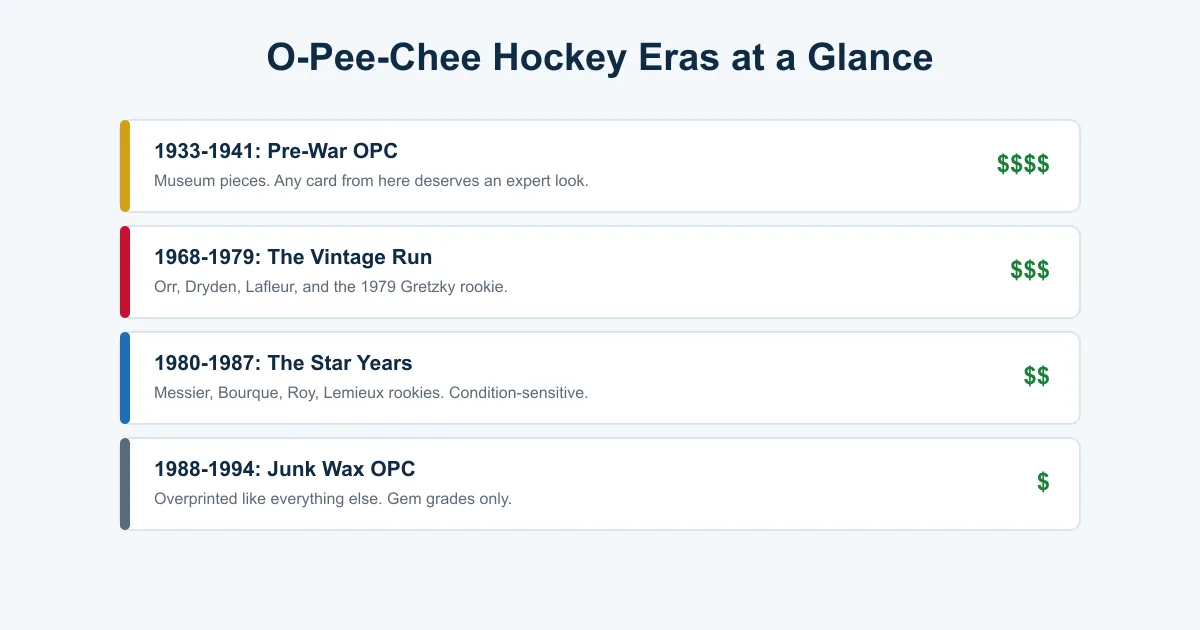
- 1933-1941, pre-war. Museum territory. If you have one of these, skip the internet and talk to an auction house.
- 1968-1979, the vintage run. The core of OPC value: Orr’s prime, Dryden and Lafleur rookies, and the 1979 Gretzky rookie at the summit. Even commons in true gem grades sell.
- 1980-1987, the star years. Messier, Bourque, Yzerman, Roy, and Lemieux rookies. Print runs grew, so value concentrates hard in the rookies and the grades.
- 1988-1994, junk wax OPC. The brand joined the overprinting party like everyone else. Gem-graded star rookies only.
- 1997-present, Upper Deck’s OPC. Fun, affordable, nostalgic. Collect it because you like it; the values are modest by design.
The OPC Cards Worth the Most
The short list every OPC collector knows:
- 1979 O-Pee-Chee Wayne Gretzky rookie #18. The card. $3.75 million as a PSA 10, four figures even in mid-grade.
- 1971 O-Pee-Chee Ken Dryden rookie #45. Black borders that chip if you look at them. Gems are five figures.
- 1985 O-Pee-Chee Mario Lemieux rookie #9. Six figures in PSA 10 thanks to brutal 80s print quality.
- 1986 O-Pee-Chee Patrick Roy rookie #53. The greatest goalie’s rookie, five figures in gem.
- 1971 O-Pee-Chee Guy Lafleur rookie #148. Habs royalty with deep Canadian demand.
- 1984 O-Pee-Chee Steve Yzerman rookie #67. A tough gem and a loyalty icon.
Full checklists for every OPC set live at the Trading Card Database, which is my go-to for identifying exact cards and numbers before looking up prices.
Which OPC Era Is My Card From?
Enter the year on the card back (or the season on the front) and get the era verdict:
OPC Era Checker
Date your O-Pee-Chee card and see what to do with it.
Valuing Your OPC Cards
Same process as any card, with two OPC-specific twists:
- Identify the exact card on the Trading Card Database: year, set, number. OPC and Topps numbering often differs, so don’t assume.
- Search eBay sold listings with “OPC” or “O-Pee-Chee” in the query, using the step-by-step method. Otherwise Topps results contaminate the comps and drag your estimate down.
- Mind the condition gap. Vintage OPC prices spread enormously across grades. Value your card at the grade it would honestly earn, using the condition checklist, not at the PSA 9 price you saw first.
If your OPC survivors pass the value check, you have a genuinely fun decision between grading first or selling raw. And if the binder turns out to be all 1990 OPC Premier commons, well, at least the wax smelled great.
Values move with the market. Verify against current sold listings before buying, selling, or grading.
Frequently Asked Questions
Are O-Pee-Chee hockey cards worth anything?
The 1968 to 1987 runs contain most of the value, including the 1979 Gretzky rookie and star rookies of the 70s and 80s. OPC from 1988 to 1994 is junk wax era and mostly worthless, and modern OPC is a budget-friendly set with modest values.
What does O-Pee-Chee mean?
O-Pee-Chee is named after the company founders' candy business in London, Ontario. The name reportedly comes from an Ojibwe word appearing in Longfellow's poem The Song of Hiawatha.
Is O-Pee-Chee worth more than Topps?
Usually yes for the same card and year. OPC had smaller print runs and rougher card stock, so high-grade copies are scarcer, and the bilingual Canadian versions carry hobby cachet. In top grades the OPC premium can be several times the Topps price.
Does O-Pee-Chee still exist?
The brand lives on under Upper Deck, which releases an O-Pee-Chee set most seasons as its affordable, retro-flavored line. The original company stopped making cards in the mid-90s.