Are 90s Hockey Cards Worth Anything? The Honest Answer

You found a binder of 90s hockey cards and the stars are all there: Gretzky, Lemieux, Roy, a wall of rookies. Time for the honest answer nobody wants to give you: almost none of it is worth anything, and it’s not close.
I say this as someone with a monster box of 1990-91 Pro Set that I still can’t throw out. This guide explains exactly why 90s cards are nearly worthless, and then walks through the four real exceptions, because a few 90s cards genuinely are worth money and they hide in the same binders as the junk.
Key Takeaways
- Cards from roughly 1988 to 1994 were printed by the millions. Supply swamps demand forever.
- The player doesn't matter when the print run is infinite: even Gretzky commons sell for cents.
- Four exceptions are real: 1990-91 Upper Deck rookies in gem grades, scarce mid-90s inserts, graded PSA 10 star rookies, and oddball regional issues.
- Sort the binder once, check the shortlist against sold prices, and enjoy the rest guilt-free.
Table of Contents
What the Junk Wax Era Actually Was
From roughly 1988 to 1994, card manufacturers discovered that printing cards was basically printing money, so they printed like it. Pro Set, Score, Topps, Bowman, O-Pee-Chee, and a crowd of newcomers ran the presses around the clock. Nobody published print runs, but industry estimates put many junk wax releases in the millions of copies per card.
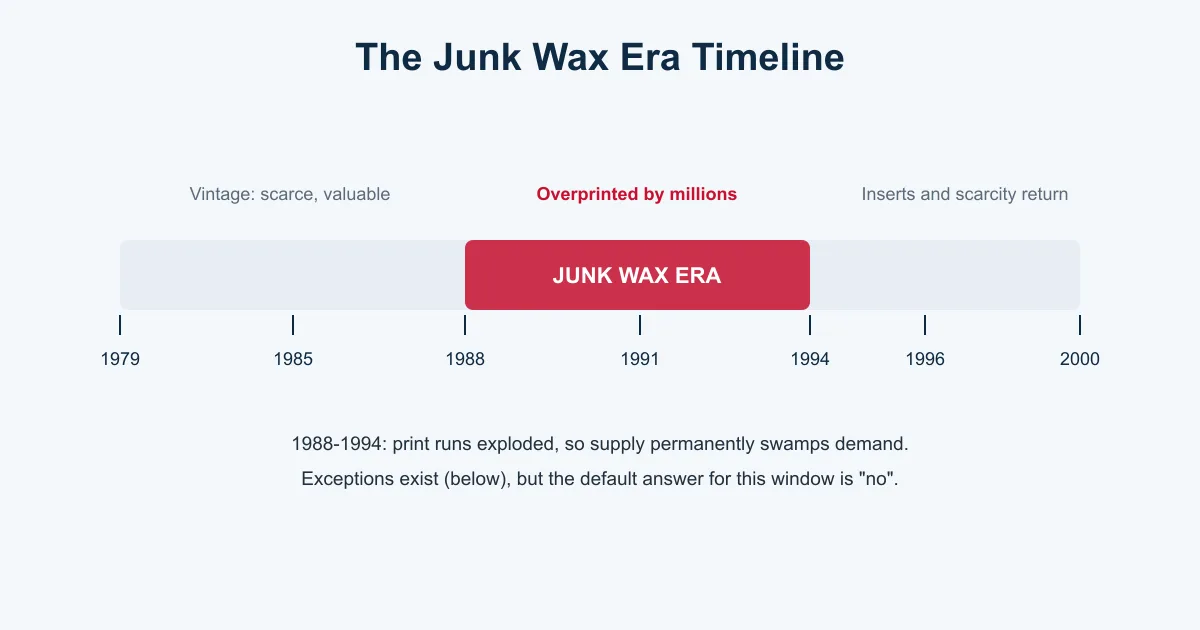
Compare that to the vintage era, when a card had to survive four decades of bike spokes, shoeboxes, and moms cleaning attics. Scarcity built six-figure vintage cards by accident. The junk wax era built the opposite by design: a supply of cards so large that demand can never catch up, no matter how nostalgic we all get.
The era ended when the market crashed in the mid-90s and manufacturers pivoted to scarcity: inserts with steep pack odds, serial numbers, and eventually autographs and patches. That pivot is also why some mid-90s cards escape the junk label, which matters for the exceptions below.
Why Star Power Doesn’t Save These Cards
Here’s the mental model that finally makes it click: price is set by the scarcest thing, and in 1990 nothing was scarce.
A 1990-91 Pro Set Gretzky is a card of the greatest player ever, and it sells for well under a dollar, because every collector who wants one can have ten by Friday. Meanwhile a 1979 O-Pee-Chee Gretzky in mid-grade sells for four figures. Same player, same cardboard rectangle. The difference is that one exists in the millions and the other survived 1979.
So when sorting 90s cards, retrain your eye. The question is never “is this player good?” The question is “is this specific card scarce in some way?” That’s exactly what the four exceptions have in common.
The Four Exceptions Worth Real Money
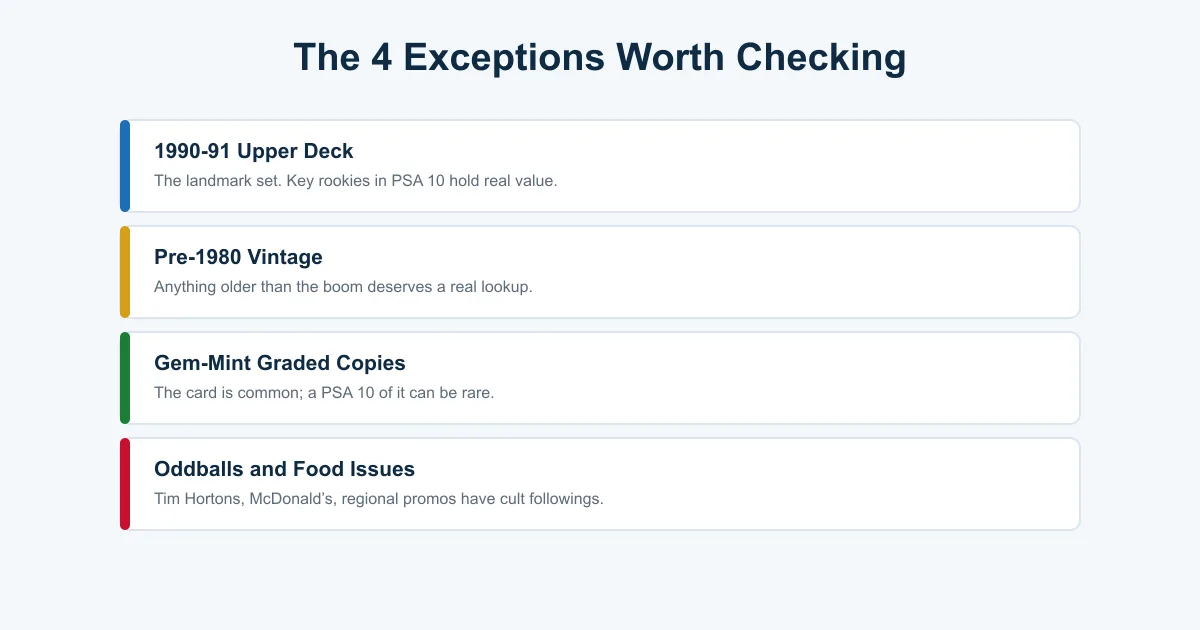
- 1990-91 Upper Deck, graded gems. Upper Deck arrived with premium stock and photography, and its key rookies (Jagr especially) are real cards in PSA 10. Raw? Still nearly worthless. The grade is the asset: check the PSA population report and you’ll see gem populations are small relative to the print run.
- Scarce chase inserts. By 1993-95, inserts with tough pack odds were the whole game. Star cards from those runs hold value in a way base cards never will. I cover which ones in the hologram and insert guide.
- PSA 10 star rookies. Sakic, Brodeur, Lindros, Mogilny: common cards, uncommon in perfect condition. A junk-era rookie that grades gem mint can be a three-figure card while the raw copy next to it is a quarter. Condition is doing all the work, so check condition honestly before dreaming.
- Oddballs and regional issues. Tim Hortons, McDonald’s Upper Deck, arena giveaways, and Kraft cards have cult followings, partly because collations were regional and sets are annoying to complete. Values are modest but real: check SportsCardsPro before assuming a McDonald’s Gretzky is junk.
The Ten Minute Binder Triage
My actual process for a 90s collection, honed on my own boxes:
- Pull the top-15 names only. Gretzky, Lemieux, Roy, Jagr, Sakic, Brodeur, Lindros, Bure, Fedorov, Mogilny, Yzerman, Messier, Hull, Selanne, Forsberg. Everything else stays.
- From those, keep only rookies, inserts, and anything serial-numbered. Base cards of stars go back in the binder.
- From those, keep only cards that look perfect. Sharp corners, centered, clean surface. Be brutal; graders will be.
- Check the survivors against sold listings on eBay. The step-by-step method takes two minutes per card.
Most collections produce a shortlist of zero to five cards. That’s normal, and it’s still worth the ten minutes: the one 1990-91 Upper Deck Jagr that grades a 10 pays for a lot of disappointment.
Is My 90s Card Worth Anything? Checker
Answer three questions and get the honest verdict:
90s Card Reality Check
A blunt triage tool for junk wax era cards.
What to Do With the Rest
The 99 percent that fails triage still has options. Bulk lots sell on Facebook groups for a few cents a card to set builders and crafters. Some local shops take donations for kids’ starter packs, which is a genuinely nice use. And honestly, a binder of 1991 cards is a better time capsule than an investment: I’d rather flip through mine than sell it for eight dollars.
Whatever you do, don’t pay to grade junk wax base cards hoping for a miracle (the grading math is unforgiving on this), and don’t pay for storage on a collection worth less than the tote it sits in. If you do find a survivor worth selling, here’s where to sell it for the most money.
Values move with the market. Verify anything against current sold listings before buying, selling, or grading.
Frequently Asked Questions
Are 1990 hockey cards worth anything?
Almost never. 1990 sits at the peak of the junk wax era, when Pro Set, Score, Topps, Bowman, and O-Pee-Chee printed millions of every card. Even stars from 1990 sets typically sell for under a dollar raw.
Are 1990-91 Upper Deck hockey cards worth anything?
Raw copies are worth very little, but 1990-91 Upper Deck is the one flagship set from the era where key rookies in PSA 10 hold real value, because Upper Deck print quality still made gems uncommon.
Are Pro Set hockey cards worth anything?
Pro Set printed more cards than anyone during the junk wax boom, and virtually nothing from it carries value today. Keep them for nostalgia, not for profit.
What 90s hockey cards are worth money?
Graded gem-mint star rookies (Jagr, Sakic, Brodeur, Lindros), scarce chase inserts from the mid-90s, early serial-numbered parallels, and oddball regional issues. Everything else needs sentimental value to justify the shelf space.